Two years of building things and finding out what people made of them. Three habits started here: prototype early, take the prototype to the people who would use it, and treat the awkward result as the finding.
Therapy games for children with cerebral palsy
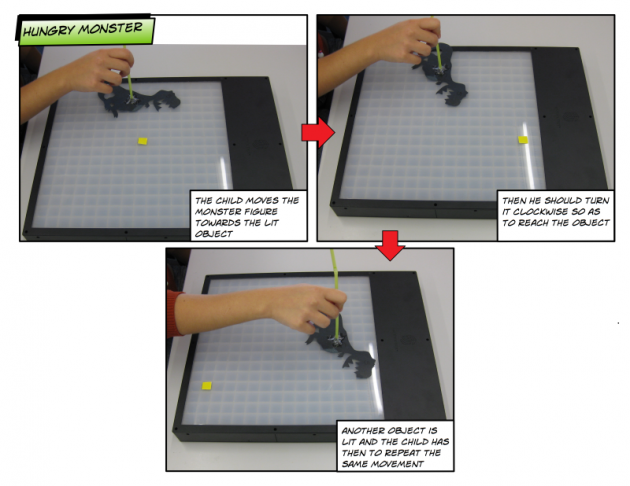
Customisable games for the TagTiles tangible board, designed iteratively and evaluated with children in real therapy settings. Two audiences had to be satisfied at once and they want different things. The child wants a game. The therapist needs an exercise that can be re-aimed at a specific movement this week, so customisation had to be built in from the start. Presented as a demo at INTERACT 2011.
A multimodal navigation stick
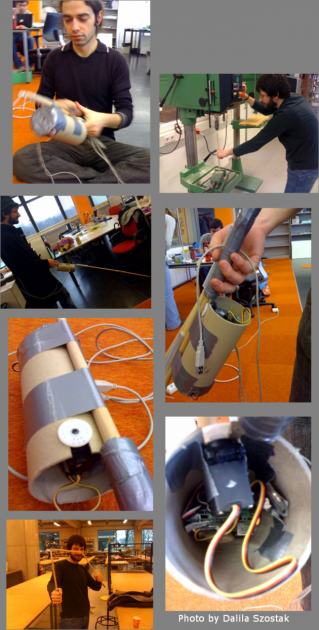
A white cane that guided its user through tactile feedback and a directional cue, with a speech menu in place of a display. We built a working prototype in wood and plastic on a Phidget board. We evaluated it with sighted participants in an artificially sight-free environment, which limits what the results say. It tests the mechanics of the feedback, without the skill a long-term cane user brings.
Culture and expressiveness with a speech interface
We built a speech driven train booking prototype, seeded it with errors, and observed the non-verbal behaviour of Greek and Dutch participants when it misheard them. The Greek participants were markedly more expressive. Systems that infer frustration from a face or a voice inherit a baseline, so a detector trained in one place will over-read one group and miss another. Published as a full paper at INTERACT 2011.
Video prototypes and visual fidelity
We built the same video prototype twice, once with actors and once with stick figures, and showed both to participants. The simpler version drew as much feedback as the polished one and was rated no less appealing. We called the difference visual fidelity. I still use the lesson: an unfinished looking prototype gets people arguing with the concept. British HCI 2011.
A remote control for older users
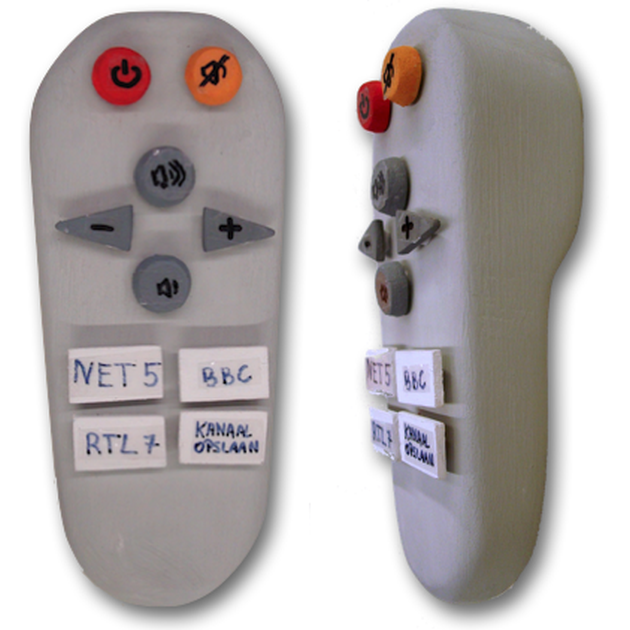
Simplicity, readability and quick access to the few functions people really use. The numeric keypad went entirely, replaced by stored favourites, and the body was shaped for one hand or two. Designed after a review of the gerontechnology literature and evaluated with older participants. Most of the improvement came from removal. Report (PDF).
Sound design for a steam cooker
Button feedback, a completion chime and an alarm, designed around the limits of human hearing and the noise of a real kitchen. A sound that tests well in a quiet room disappears under an extractor fan, and an alarm has to be distinguishable from every other beeping object on the counter.
- Button feedback, meal ready, alarm (MP3)
A tangible prototyping tool for architects
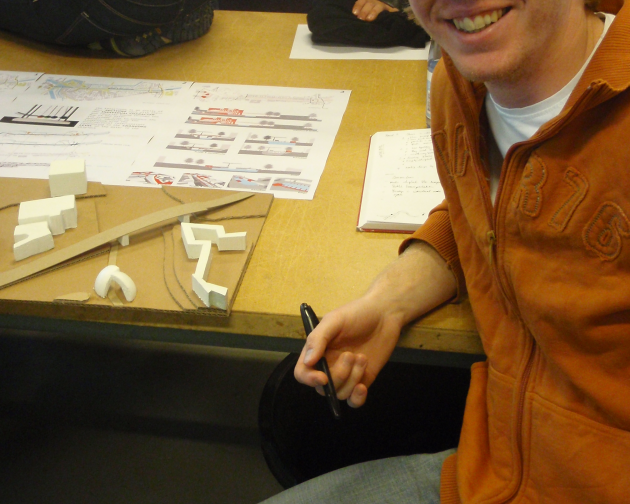
Generic wooden shapes standing in for architectural volumes, arranged by hand on a sensing surface and exported as a 3D model. The aim was to keep the fast, physical stage of design intact and digitise afterwards. Refined with architecture teachers and students at TU Eindhoven. Presentation (PDF).
A custom electronic instrument
An electronic instrument in the shape of a bat: two sliders, two touch sensors, no frets, and a distortion function. Max 5 for sound, Arduino for sensing. Instrument design gives very direct feedback, since latency and mapping problems are audible immediately. Video.
Chooz!
A web game about taste. Three images appear, one player picks a favourite in secret, everyone else guesses which. The question underneath was whether images can carry the non-verbal signal that keeps remote conversation warm, in a setting where text is usually all anyone has. Video.
Instructors: Panos Markopoulos, Emiel Krahmer, Marc Swerts, Jacques Terken, Laurence Nigay, Bert Bongers, Don Bouwhuis, Dik Hermes, Bill Verplank, Koen van Turnhout
Collaborators: Angeliki Angeletou, Peter Banach, Miroslav Bojic, Beant Kaur Dhillon, Jorge Peregrin Emparanza, Areti Goulati, Rafal Kocielnik, Agata Raczewska, Ryo Sakai, Leoni van de Sande, Dalila Szostak, Jonathan van Wijngaarden